

It’s that time of year — allergy season. The warm weather is here and everything is blossoming. Here are some recommendations for allergy treatments.
First-line treatment for mild seasonal allergies includes oral second-generation antihistamines (cetirizine, fexofenadine, loratadine, levocetirizine, desloratadine) or intranasal antihistamines (azelastine, olopatadine).
Cetirizine, fexofenadine, and loratadine are available over-the-counter: Cetirizine: Zyrtec, Fexofenadine: Allegra, Loratadine: Claritin, Alavert
Intranasal azelastine antihistamines are prescription-only in the United States and are not available over the counter.
For moderate to severe symptoms, intranasal corticosteroids (fluticasone, mometasone, budesonide, triamcinolone) are the most effectivemonotherapy. [1-3]
All four intranasal corticosteroids are now available over-the-counter (OTC) — they include Flonase, Nasonex, Rhinocort, and Nasacort.
The following table outlines the stepwise approach to treatment based on symptom severity:
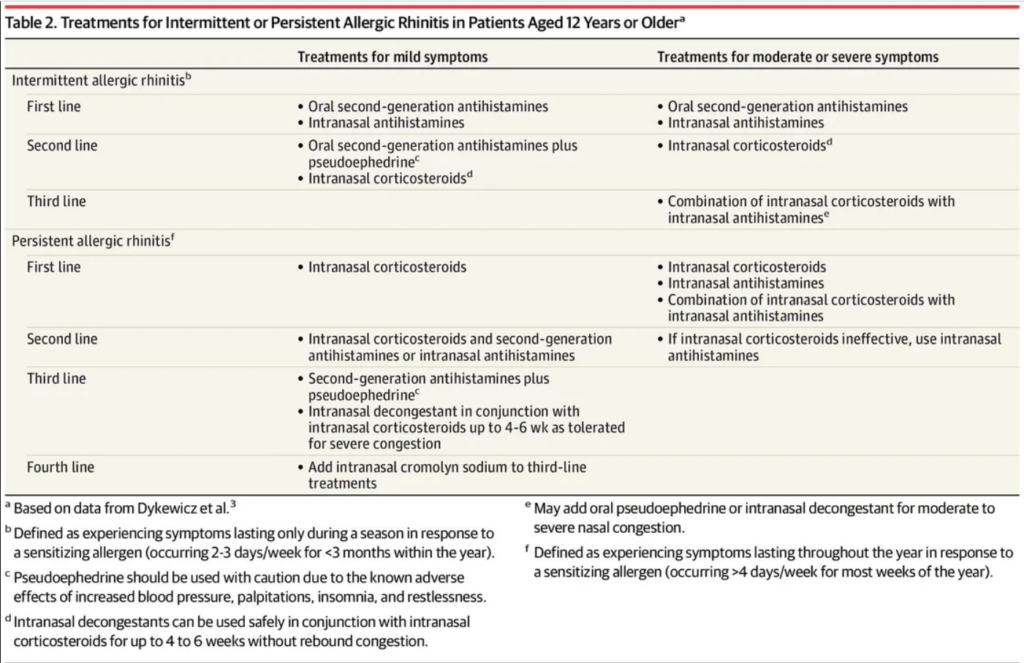
Mild intermittent symptoms: Oral second-generation antihistamines or intranasal antihistamines are appropriate first-line options. These medications have rapid onset and can be used on an as-needed basis. Many are available over the counter, including loratadine, cetirizine, and levocetirizine. [1]
Moderate to severe symptoms: Intranasal corticosteroids are considered the most effective pharmacotherapy for seasonal allergic rhinitis and are recommended as first-line topical monotherapy by most consensus guidelines. [1][3] The 2017 Joint Task Force on Practice Parameters strongly recommends intranasal corticosteroid monotherapy over combination therapy with oral antihistamines for initial treatment. [2] Clinical effects appear within a day, though peak effect may take several weeks. [3]
Combination therapy: For moderate to severe seasonal allergic rhinitis, the combination of an intranasal corticosteroid and intranasal antihistamine may be considered for initial treatment. [2] This approach can be more effective than monotherapy in patients with persistent or severe symptoms. [1]
Additional considerations: Saline nasal irrigation may reduce symptom severity and is relatively inexpensive. [1] Oral decongestants (pseudoephedrine) can be added for severe congestion but should be used with caution due to cardiovascular side effects. [1] Topical nasal decongestants should only be used short-term (up to 4-6 weeks) to avoid rebound congestion. [1][3] Leukotriene receptor antagonists like montelukast are less preferred than intranasal corticosteroids and carry a boxed warning for neuropsychiatric effects. [1-2]
Severe exacerbations: A short course of oral corticosteroids (35-40 mg for 5-7 days) may be appropriate for severe acute exacerbations, but intramuscular corticosteroids are not recommended. [1]
If you need some further guidance or do not respond to over-the-counter remedies, then please reach out to our office at (707) 938-1255 to schedule a visit.

MD, Board-Certified Internist, Concierge Medicine Physician
Dr. Guy Delorefice has been practicing in Sonoma County since 1999 as a board-certified internist. He earned a degree in Biology from St. Mary’s College of California, then completed his medical degree at Creighton University. While at Creighton, he launched medical clinics in third-world countries and became fluent in Spanish. His internship and internal medicine residency were completed at Providence St. Vincent’s Medical Center in Portland, Oregon. After finishing his training, he relocated to Sonoma County to be closer to home and family. Dr. Guy has built a reputation for exceptional patient care and has been voted by peers as a top physician in his specialty in consecutive years.
Outside medicine, he is deeply family-oriented — married to Rebecca, father to Lani and Capri, with a black lab named Hank. He’s passionate about the outdoors and spends time mountain biking, road biking, abalone diving, fishing, hunting, and skiing. He’s often seen biking around Sonoma with his family.