

You’ve had the same primary care doctor for years, but the 15-minute appointments, the phone trees, and the weeks-long waits are getting old. Maybe a friend mentioned their concierge doctor answers texts on a Sunday, and now you’re wondering what it would actually take to make the switch.
That curiosity is where most patients start with concierge medicine in Napa and Sonoma. The idea sounds appealing, but the logistics feel murky. What happens to your current specialists? Will there be a stretch where nobody has your chart? What if you need a prescription refill during the switch?
This guide walks you through the transition from a traditional hospital-based primary care doctor to a concierge practice, step by step, so you can plan the switch without gaps in your care.
Key Takeaways
- Most patients complete the switch to a concierge practice in 2 to 4 weeks.
- You keep your existing specialists, your insurance, and your pharmacy. Concierge care replaces your primary care doctor, not your whole care team.
- A signed medical records release is the single most important step for avoiding gaps in care.
- Time your last refills, upcoming tests, and specialist follow-ups before you cancel with your current primary care office.
- The initial consultation with a concierge doctor is usually free and helps you decide whether the fit is right.
- Concierge medicine in Napa and Sonoma County works alongside your insurance, not instead of it.
What Concierge Medicine Includes
Concierge medicine is a membership-based model where you pay an annual or monthly fee directly to your primary care doctor. In exchange, the doctor intentionally keeps a much smaller patient panel, usually 300 to 600 patients instead of the 2,000 to 3,000 a traditional primary care doctor carries.
That smaller panel is what makes same-day appointments, longer visits, and direct cell phone access possible.
A few things worth knowing before you switch:
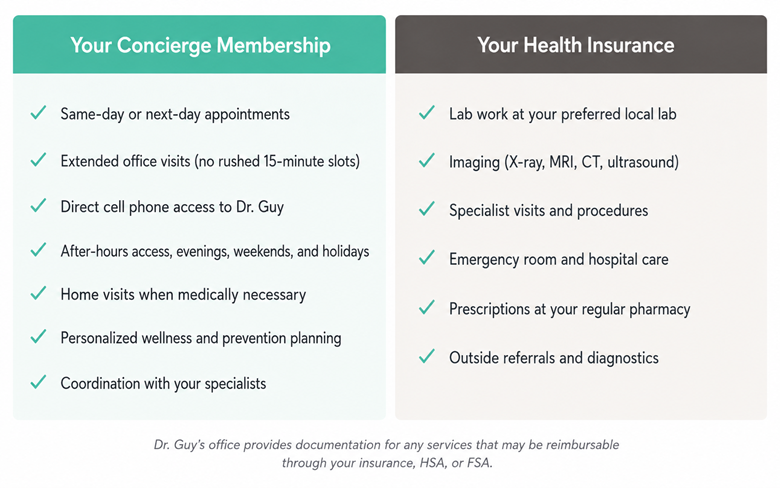
- Your health insurance stays active. You still use it for labs, imaging, specialists, hospital stays, and prescriptions.
- The membership fee itself isn’t billed to insurance, though some of the underlying services may be reimbursable with documentation.
- Concierge care replaces your primary care doctor. Everyone else in your care team stays put.
For most patients in Napa and Sonoma, the switch is simpler than it sounds.
The Transition Process, from First Call to First Visit
Step 1: Book a Consultation
Almost every concierge doctor offers a free introductory consultation. Use it. This is where you find out whether the doctor’s approach fits how you want to be cared for.
Come with questions. Ask about:
- Panel size
- After-hours access
- Home visits
- How prescriptions are handled
- What happens when the doctor is on vacation
- The fee and what it does and doesn’t include
Bring a list of your current medications, conditions, and specialists. It makes the consultation more useful for both of you.
Step 2: Confirm Your Specialists and Insurance Stay in Place
Short answer: nothing changes with your specialists. Your specialists stay yours. Your cardiologist, dermatologist, endocrinologist, orthopedist, and any other specialist you see keeps seeing you the same way they always have.
Your health insurance keeps covering those visits. It also keeps covering:
- Lab work at your preferred local lab or hospital-based labs
- Imaging (X-ray, MRI, CT, ultrasound)
- Specialist visits and procedures
- Emergency room and hospital care
- Prescriptions at your regular pharmacy
The concierge membership fee is separate from insurance. It covers your relationship with your primary care doctor, not the rest of the healthcare system.
Step 3: Request Your Medical Records
Once you’ve decided to enroll, request a full copy of your medical records from your current primary care doctor. Most practices require a signed release form, which you can usually download from their patient portal or pick up in person.
Ask for the records to be sent directly to your new concierge practice. Include:
- Recent office visit notes (last 2 to 3 years is typical)
- Lab and imaging results
- Immunization records
- Specialist consult notes
- Current medication list and allergies
- Any active referrals or care plans
Records transfers can take 2 to 4 weeks. Start this step before you cancel with your current practice, not after.
Step 4: Time the Transition Around Your Care Schedule
Look at the next 90 days and map out anything already on the calendar:
- Prescription refills due
- Upcoming lab work or annual physicals
- Specialist follow-ups
- Scheduled imaging or procedures
If your blood pressure medication needs a refill in 3 weeks, get that refill from your current doctor before you cancel. If your annual physical is scheduled for next month with the new concierge practice, plan the enrollment date to fit.
A short overlap with your current doctor is normal. Cancel only after your records are transferred and your first concierge appointment is confirmed.
Step 5: Have Your First Concierge Visit
The first visit with a concierge doctor is typically 60 to 90 minutes. This is where the doctor learns your full history, reviews your records, and builds a plan with you.
Bring your medication bottles, a list of your specialists with contact information, and any questions you’ve been holding onto.
After this visit, you should have the doctor’s direct contact information and a clear sense of how to reach the practice when something comes up.
Common Mistakes to Avoid While Making the Switch
- Canceling with your current doctor too early. Wait until records are transferred and your first concierge visit is booked.
- Assuming your specialists will change. They don’t. Your care team stays the same except for your primary care doctor.
- Skipping the records transfer. Without it, your new doctor is starting from scratch, and that costs you time and continuity.
- Choosing based on price alone. The fee matters, but so does the doctor’s philosophy, availability, and whether you actually connect with them.
See What Concierge Medicine Looks Like for You
The easiest way to find out whether concierge care is right for you is a free introductory consultation with Dr. Guy. You can ask every question on your list, and there’s no pressure to enroll.
Dr. Guy has practiced internal medicine in Sonoma County since 1999. His concierge practice serves patients across Napa and Sonoma Counties who want a primary care relationship that isn’t rushed.
Call (707) 938-1255 or contact our team online to schedule your consultation.
Frequently Asked Questions

MD, Board-Certified Internist, Concierge Medicine Physician
Dr. Guy Delorefice has been practicing in Sonoma County since 1999 as a board-certified internist. He earned a degree in Biology from St. Mary’s College of California, then completed his medical degree at Creighton University. While at Creighton, he launched medical clinics in third-world countries and became fluent in Spanish. His internship and internal medicine residency were completed at Providence St. Vincent’s Medical Center in Portland, Oregon. After finishing his training, he relocated to Sonoma County to be closer to home and family. Dr. Guy has built a reputation for exceptional patient care and has been voted by peers as a top physician in his specialty in consecutive years.
Outside medicine, he is deeply family-oriented — married to Rebecca, father to Lani and Capri, with a black lab named Hank. He’s passionate about the outdoors and spends time mountain biking, road biking, abalone diving, fishing, hunting, and skiing. He’s often seen biking around Sonoma with his family.